


Sep.12,2026
Share:
A telecom project in Latin America often starts with a simple question. Can the supplier deliver the right mix of fiber distribution products in one shipment? Many suppliers can make a terminal box. Some can make a rack-mounted ODF. But few can produce both, plus a fully loaded patch panel, and ship them together with consistent quality. If the products come from different factories, the adapter alignment, the pigtail lengths, and the labeling can all be slightly different. That creates problems during installation. The technician has to adjust, rework, or replace parts on site. We avoid this by manufacturing the full range in our own factory. This week, we are doing the final check on a set of samples for a customer in Colombia.
This shipment includes three product types: compact 12-port wall-mounted terminal boxes with FC or SC/UPC adapters, 19-inch sliding-tray rack-mounted ODF units with configurable adapter panels, and a fully loaded 24-port black patch panel with SC/APC adapters, color-coded pigtails, and fusion splice trays. We check every unit before packing and can customize port count, adapter type, and internal layout for each project.
Our customer in Colombia is a distributor who supports FTTH and telecom projects across the region. He asked for samples that cover different installation scenarios. Some sites need a small wall-mounted box for building distribution. Other sites need a rack-mounted ODF for the equipment room. And some projects need a preloaded patch panel that is ready for splicing and patching. Instead of sending three separate orders to three different suppliers, he asked us to prepare everything in one batch. We agreed. This is what the final check looks like.
The first product in the shipment is a set of compact 12-port wall-mounted terminal boxes. These boxes are designed for building distribution points where space is limited. A small equipment room, a communication cabinet, or a corridor wall may not have room for a large rack. The wall-mounted box solves that problem. It holds the adapters, the splices, and the excess fiber in one compact metal enclosure.
We manufacture these 12-port wall-mounted terminal boxes in two configurations. One version uses FC-type adapters with red dust caps. The other version uses twelve blue SC/UPC adapters. The metal housing provides mechanical protection, and the keyhole mounting points allow secure wall installation. Inside, there is space for fiber splicing, routing, and storage.
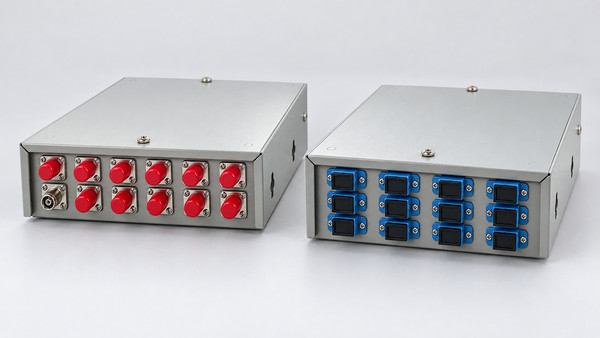
The customer asked for two versions of the same box. This is common in Latin America, where different projects may specify different connector types. Some networks use FC connectors for their ruggedness and screw coupling. Other networks use SC connectors for their push-pull design and lower cost. We built both versions in the same batch. The table below shows the configuration details.
| Configuration | Adapter Type | Dust Cap Color | Typical Use |
|---|---|---|---|
| Version A | FC | Red | Legacy telecom rooms, rugged environments |
| Version B | SC/UPC | Blue | FTTH distribution, new builds |
The metal housing is the same for both versions. Only the adapter panel and the internal mounting brackets change. This keeps the production efficient and the quality consistent.
Inside the box, we provide space for splicing, routing, and storage. The incoming cable is secured with a clamp. The strength members are anchored. The fibers are routed to the splice tray with a controlled bending radius. After splicing, the excess fiber is stored in a loop. The table below shows the main internal features.
| Internal Feature | Function |
|---|---|
| Cable entry clamp | Secures the incoming cable and strength members |
| Splice tray | Holds and protects fusion splices |
| Fiber routing guides | Maintain safe bending radius |
| Adapter panel | Holds 12 adapters in numbered positions |
| Cover plate | Protects internal components from dust |
These boxes are suitable for building distribution points, small equipment rooms, communication cabinets, and other locations where space is limited. The keyhole mounting points on the back allow the installer to hang the box on two screws. This makes single-person installation easier.
The second product in the shipment is the 19-inch rack-mounted optical distribution frame. This unit is designed for equipment rooms and telecom cabinets. It mounts in a standard 19-inch rack. The key feature is the sliding-tray design. Technicians can pull the tray forward to access the internal components without removing the entire unit from the rack.
Our 19-inch rack-mounted ODF uses a sliding-tray design for easy access during maintenance. The front panel provides numbered adapter positions for clear port identification. The panel can be configured with SC, FC, ST, or LC adapters. Inside, the enclosure includes cable-fixing clamps, a grounding point, fiber-routing guides, and fusion splice trays.
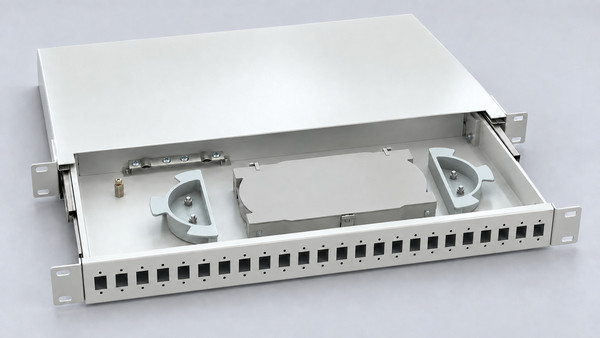
In a live network, maintenance work is often done under time pressure. The technician needs to add a splice, replace a pigtail, or trace a fault. If the ODF is fixed inside the rack, the technician has to work in a tight space with limited visibility. The sliding tray changes that. The technician pulls the tray out, does the work, and slides it back. This reduces the risk of accidental fiber damage and speeds up the task. The table below shows the main components of the ODF.
| Component | Function |
|---|---|
| Sliding tray | Provides access to internal components |
| Front adapter panel | Holds SC, FC, ST, or LC adapters |
| Cable-fixing clamps | Secure incoming cables and strength members |
| Grounding point | Provides electrical grounding for the metal housing |
| Fiber-routing area | Guides fibers with controlled bend radius |
| Fusion splice trays | Protect and organize fusion splices |
The front panel can be configured with different adapter types. The customer in Colombia has projects that use SC and FC connectors. Some future projects may use LC for high-density patching. We can supply the ODF with a panel that matches the current project and provide spare panels for future upgrades. The table below shows the common adapter options.
| Adapter Type | Port Density | Common Application |
|---|---|---|
| SC | 12 or 24 ports | FTTH, PON networks |
| FC | 12 or 24 ports | Telecom equipment rooms |
| ST | 12 or 24 ports | Legacy installations |
| LC | 24 or 48 ports | High-density data centers |
The numbered adapter positions on the front panel help the technician identify each port quickly. This reduces the chance of connecting the wrong fiber during patching or maintenance.
The third product is a fully loaded 24-port black rack-mounted fiber optic patch panel. This unit is ready for splicing and patching. It comes with adapters, pigtails, and splice trays already installed. The technician only needs to connect the incoming cable and splice the fibers.
We configure this 24-port patch panel with two 12-port adapter sections, twenty-four green SC/APC adapters, matching color-coded SC/APC single-mode pigtails, and two fusion splice trays. The color-coded pigtails make fiber identification easier during splicing and future maintenance. SC/APC connectors provide low back reflection, which is suitable for PON and FTTH access networks.
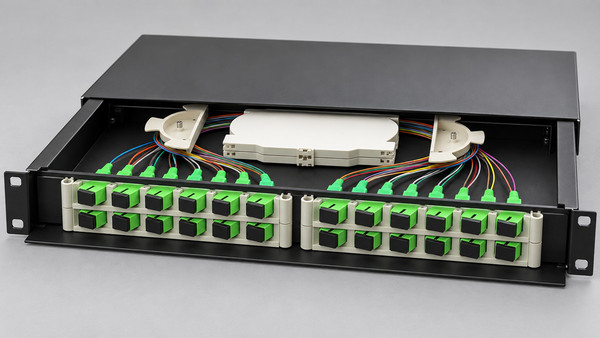
SC/APC connectors have an angled end face. The eight-degree angle directs reflected light away from the fiber core. This reduces back reflection. In PON and FTTH networks, low back reflection is important because the signal travels over long distances and passes through splitters. Too much reflection can degrade the signal quality. The table below compares the return loss of common connector types.
| Connector Type | Polish | Typical Return Loss |
|---|---|---|
| SC/UPC | Flat | ≥ 50 dB |
| SC/APC | Angled 8° | ≥ 60 dB |
| LC/UPC | Flat | ≥ 50 dB |
| LC/APC | Angled 8° | ≥ 60 dB |
For this customer, SC/APC was the right choice for their FTTH and PON projects. The green color of the adapters and pigtails is the industry standard for APC connectors. This helps technicians identify the connector type at a glance.
The patch panel comes with 24 SC/APC pigtails already installed. Each pigtail is color-coded according to the standard fiber color sequence. This makes it easy to match the pigtail to the correct adapter port. The pigtails are routed to the splice trays. The technician only needs to splice the incoming cable fibers to the pigtail ends. The table below shows the standard 12-fiber color code we use.
| Fiber Number | Color | Fiber Number | Color |
|---|---|---|---|
| 1 | Blue | 7 | Red |
| 2 | Orange | 8 | Black |
| 3 | Green | 9 | Yellow |
| 4 | Brown | 10 | Violet |
| 5 | Slate | 11 | Rose |
| 6 | White | 12 | Aqua |
For a 24-port panel, we use two sets of this color code. The first 12 pigtails follow the standard sequence. The second 12 pigtails repeat the sequence with a different binder or marking. This keeps the identification clear even in a high-density panel.
Before any product goes into the shipping box, we do a final check. This is not a quick glance. We check each unit against the order requirements. The goal is to catch any problem before the product leaves our factory. A sample that arrives with a missing accessory or a misaligned adapter wastes the customer's time and delays the project evaluation.
We check the metal housing, sliding mechanism, rack-mounting brackets, adapter alignment, internal accessories, and pigtail arrangement. Preloaded panels also receive end-face inspection and insertion-loss testing before delivery. Only units that pass all checks are packed for shipment.
The table below shows the inspection items we use for this Colombia shipment.
| Check Item | What We Look For |
|---|---|
| Metal housing | No dents, scratches, or sharp edges |
| Sliding mechanism | Smooth movement, no sticking |
| Rack-mounting brackets | Correct size, secure attachment |
| Adapter alignment | Adapters sit flush, no tilting |
| Internal accessories | Splice trays, clamps, and guides present |
| Pigtail arrangement | Correct color sequence, neat routing |
| End-face inspection | No scratches, dust, or contamination |
| Insertion loss test | Within specification for each port |
For the 24-port patch panel, we also test insertion loss on every port. The customer wants to know that the preloaded pigtails and adapters work together without high loss. We record the test data and include it with the shipment. This gives the customer a clear record of the product performance before they install it.
After the final check, each unit is cleaned and packed. The wall-mounted boxes are wrapped in foam and placed in individual cartons. The rack-mounted ODF and patch panel are packed with corner protectors and secured inside sturdy boxes. We label each carton with the product model, quantity, and batch number. The shipment is then prepared for the journey to Colombia.
Every project has its own requirements. A wall-mounted box for a building in Bogota may need different adapters than a rack-mounted ODF for a data center in Medellin. We do not force customers to choose from a fixed catalog. We build the product to match the project.
We can customize port capacity, adapter type, pigtails, splice trays, housing color, logo, labeling, and packaging according to each project. This applies to terminal boxes, rack-mounted ODF units, patch panels, and other fiber distribution products.
The table below shows the main customization options for the products in this shipment.
| Product Type | Customization Options |
|---|---|
| Wall-mounted terminal box | Port count, adapter type, housing color, logo, cable entry |
| Rack-mounted ODF | Port count, adapter type, sliding or fixed tray, panel labeling |
| Patch panel | Port count, adapter type, preloaded pigtails, splice trays, color |
| All products | Packaging, labeling, test reports, spare parts |
The customer in Colombia supports FTTH and telecom projects across Latin America. He needs a supplier who can deliver consistent quality across different product types. He also needs a supplier who understands the regional market. We have experience with projects in North America, Europe, the Middle East, and Latin America. We know that different regions have different preferences for connector types, cable colors, and labeling languages. We can adapt our products to match those preferences.
This sample shipment for Colombia includes three types of fiber distribution products. The 12-port wall-mounted terminal boxes handle building distribution in small spaces. The 19-inch sliding-tray ODF units provide accessible fiber management in equipment rooms. The fully loaded 24-port SC/APC patch panel is ready for splicing and patching in PON and FTTH networks. We checked every unit before packing. We tested the preloaded panels for insertion loss and inspected the end faces. We packed the products for safe international shipping. If your project needs fiber distribution products with custom configurations and consistent quality, Alteoptic can support you from sample evaluation to batch production. Contact us to discuss your next project in Colombia or anywhere in Latin America.
YOUR VACATION IS HERE
Prepare your network for seamless 5G deployment. Get direct access to factory pricing, custom OEM/0DM solutions, and rapid prototyping,
Let's Build Your Optical Network, Kindly have a chat with our sales experts!
Get A Free Quote
Related Products

Fiber End Face Cleaning Box SC/FC/LC/ST Connector Cleaner Tools Optical Fiber Flange Cleaner
Alteoptic cleaning cassette Fiber Optic Connector Cleaning cassette can quickly clean the end face of various optical fiber connectors without using cleaning solvents. It is widely used in cabling field and laboratory.
View More
Fiber Network Interface Device (Fiber NID)
Alteoptic’s Fiber Network Interface Device (Fiber NID) is a high-performance outdoor fiber optic enclosure specifically engineered for FTTH, FTTB, and FTTP networks. This outdoor Fiber NID enclosure delivers secure, weather-resistant protection, providing a reliable demarcation point between the service provider’s fiber optic network and the customer premises.
View More
Compact outdoor Fiber NID with a built-in reel design. The drop cable is pre-wound on the internal reel and factory-terminated with SC/APC connectors on both ends, available up to 150 ft. The enclosure features IP55 protection with foam strip sealing, helping protect the fiber connection point while reducing field splicing, simplifying installation, and keeping excess cable neatly stored inside the box.
View More
AUA-40A Dry Battery 4-in-1 Fiber Optic Identifier combines OFI, 10mW VFL, and LED functions in a single device. It supports both SM and MM fiber cables, offering efficient and precise fiber identification, fault detection, and testing—ideal for field use in fiber optic networks.
View More
MINI Charging Type Live Detector Identifier is a 4-in-1 fiber tester featuring OFI, OPM, 30mW VFL, and LED. Designed for both SM and MM fibers (800-1700nm), this orange device offers precise live fiber detection, optical power measurement, and fault location, making it perfect for efficient fiber optic testing and maintenance.
View More
Unveil the aletoptic AUA800U/800A OTDR, a 100KM handheld machine tester with UPC & APC interfaces. This Optical Time Domain Reflectometer, equipped with OPM, VFL, & OLS, operates at 1310/1550nm for comprehensive fiber analysis, ideal for field technicians.
View More
The KP900 OTDR is an all-in-one handheld fiber tester with UPC/APC ports. Integrated with 9 professional testing functions and a 4.3-inch HD touch screen, it supports fiber fault locating, link testing and network cable detection. Lightweight and battery-powered, it is ideal for broadband maintenance, engineering construction and outdoor field work.
View More
AUA900D/900A OTDR offers advanced fiber testing with UPC and APC interfaces. This 60KM, 9-in-1 multifunctional device operates at 1310/1550nm, providing comprehensive optical fiber diagnostics for efficient network maintenance and troubleshooting.
View More
AUA-16 UPC/APC interface optional optical time domain reflectometer measurement range 80KM 1550nm five in one multifunctional OTDR fiber testing instrument fiber testing equipment intelligent mini OTDR
View More
AUA-20 Fiber Optic OTDR Launch Cable Box offers SC/FC/ST/LC connectors with UPC/APC options. Customizable in length, type, and connector, it ensures precise and reliable OTDR testing for various needs. Ideal for professional fiber optic testing.
View More