


Sep.22,2026
Share:
A large export order can expose every weakness in a factory. If the housing material is inconsistent, some units crack in the field. If the sealing components are not torque-tested, water gets inside. If the packaging is weak, the cartons arrive crushed after a long sea voyage. These problems multiply when the order is 10,000 units. A single defect rate of one percent means one hundred failed closures on site. That is why we treat every large batch as a test of our whole production system. Right now, our factory is running a 10,000-unit order of the ALT1-H-120 splice closure for a customer in Spain. Let me show you how we build it, test it, and pack it.
We are manufacturing 10,000 units of the ALT1-H-120 fiber optic splice closure for a Spanish telecom project. The closure uses a high-grade PC+ABS housing, holds up to 5 splice trays with 24 fibers each for a total capacity of 120 cores, carries an IP65 rating, and ships with a full accessory kit. Every unit goes through material inspection, torque-tested sealing assembly, and export-grade packaging before sea freight to Spain.
This order will support local telecom, CATV, and fiber optic broadband networks across Spain. The customer chose our ALT1-H-120 model because it works for both aerial mounting and underground burial. That flexibility matters in Spain, where network operators deal with different terrain and installation conditions in different regions. The order is now moving through our production line. Here is what happens at each stage.
The housing is the first line of defense for any outdoor splice closure. It faces sunlight, rain, dust, and temperature changes for years. If the plastic material is weak or the molding process is inconsistent, the housing can crack, warp, or fade. Once the housing fails, the fibers inside are exposed. That is why we start quality control at the raw material stage, not at the end of the line.
We build the ALT1-H-120 enclosure from high-grade PC+ABS engineering plastic. We keep strict quality controls at the raw material stage. Every finished housing goes through random checks for appearance and mechanical strength, so it can resist impact and aging even under harsh outdoor conditions.
PC+ABS combines the strength of polycarbonate with the processing ease of ABS. The result is a material that resists impact, holds its shape under heat, and does not become brittle in cold weather. For a closure installed outdoors in Spain, this matters. Summer temperatures in southern Spain can exceed 40 degrees Celsius. Winter temperatures in the northern mountains can drop below freezing. The housing must handle both. The table below shows the key properties we look for in the raw material.
| Property | Why It Matters for Outdoor Use |
|---|---|
| Impact strength | Resists accidental drops and tool impacts during installation |
| UV resistance | Prevents fading and surface cracking under sunlight |
| Thermal stability | Maintains shape across hot and cold temperature ranges |
| Aging resistance | Keeps mechanical properties stable over years of service |
After injection molding, the housings move to a quality check station. We do not check only the first piece or the last piece. We pull random samples from each production batch. The inspector looks for surface defects, color consistency, and dimensional accuracy. Then the sample goes through a mechanical strength test. The table below shows the checks we perform.
| Check Item | Method | Pass Condition |
|---|---|---|
| Appearance | Visual inspection | No cracks, flow marks, or color deviation |
| Dimensions | Caliper measurement | Within drawing tolerance |
| Impact strength | Drop test on sample | No cracking or deformation |
| Lid fit | Assembly check | Closes smoothly, no gap |
If a batch fails any of these checks, we stop the line and review the molding parameters. This keeps the quality consistent across all 10,000 units.
Once the housings pass inspection, they move to the assembly line. This is where the closure becomes a functional fiber management system. Our technicians fit the splice trays, cable sealing parts, and locking latches one by one. This step looks simple from a distance. But the internal layout decides whether the closure works well in the field. A poorly routed fiber can bend too sharply and lose signal. A loose sealing part can let water inside.
Our technicians assemble each ALT1-H-120 with up to 5 splice trays, cable sealing parts, and locking latches. Each tray supports 24 fibers, giving a total capacity of 120 cores. We pay close attention to internal cable routing so there is enough space to maintain a proper fiber bend radius. All screw-type mechanical sealing components are torque-tested before the unit moves forward.
The ALT1-H-120 holds up to 5 splice trays. Each tray supports 24 fibers. That gives a total capacity of 120 cores. This capacity suits backbone splicing and distribution points where many fibers come together. The internal space is designed so the fibers can be routed without sharp bends. We keep the bend radius above the minimum value for the fiber type. A tight bend increases attenuation and can cause a micro-crack over time. The table below shows the tray configuration.
| Parameter | Specification |
|---|---|
| Maximum splice trays | 5 |
| Fibers per tray | 24 |
| Total fiber capacity | 120 cores |
| Tray material | High-strength plastic |
| Fiber routing | Controlled bend radius guides |
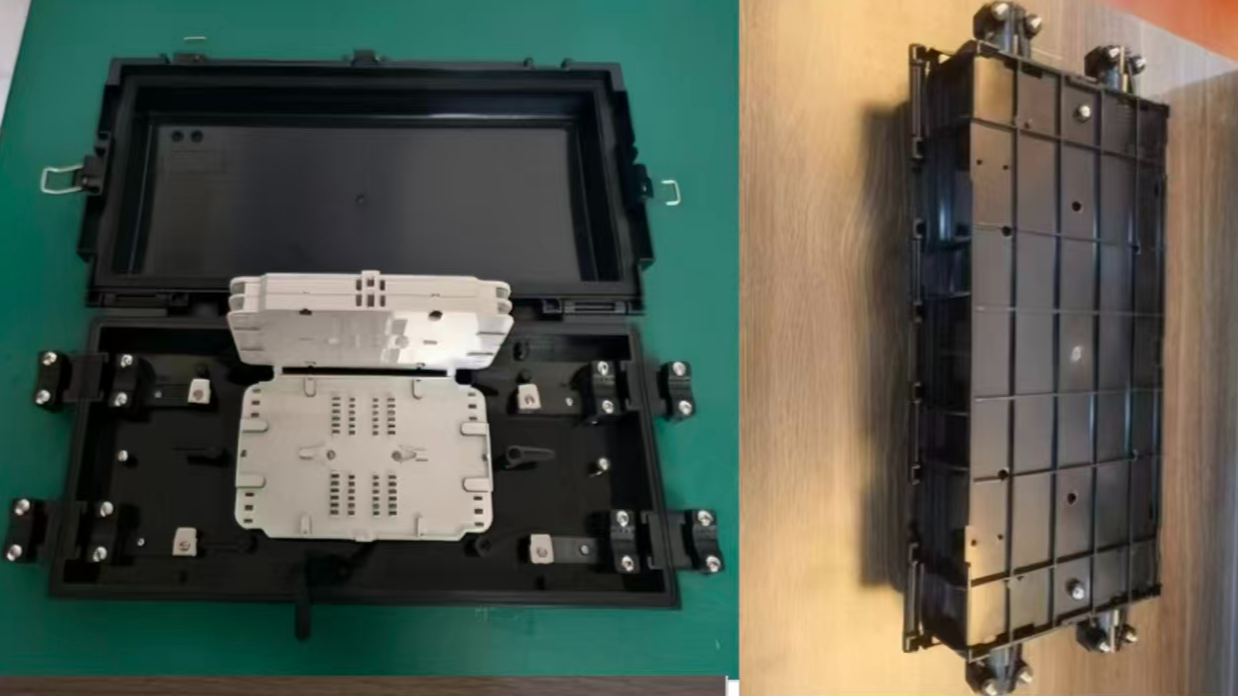
The ALT1-H-120 uses screw-type mechanical sealing. The screws compress the sealing gasket against the cable and the housing. If a screw is too loose, the seal leaks. If a screw is too tight, the gasket deforms and loses its sealing ability. Our technicians use a torque tool to tighten every sealing screw to the specified value. This step is quick but critical. The table below shows the sealing structure of the closure.
| Sealing Point | Method | Test |
|---|---|---|
| Cable entry ports | Screw mechanical seal | Torque check |
| Housing lid | Gasket and screws | Torque check |
| Cable exit ports | Screw mechanical seal | Torque check |
This torque testing lays a solid foundation for reliable field-site outdoor performance. Without it, even a well-made housing can leak.
Every closure model has a set of specifications that determine where it can be installed and how many fibers it can hold. The ALT1-H-120 is one of our workhorse models in the outdoor splice closure lineup. The customer in Spain chose it because the specifications match their network design. Let me walk through the main numbers.
The ALT1-H-120 comes in black with an IP65 protection rating for dust-proof and waterproof performance. Its overall dimensions are 442 × 207 × 92 mm. It features a 2+2 cable entry-and-exit setup with screw mechanical sealing. Both inlet and outlet ports accept cables up to 18 mm in diameter. It works for both aerial mounting and underground burial applications.
The IP65 rating means the closure is dust-tight and protected against water jets from any direction. This is important for outdoor installations where rain and dust are constant threats. The dimensions are compact enough for pole mounting but large enough to hold 120 fibers and the associated splice trays. The table below summarizes the main specifications.
| Specification | Value |
|---|---|
| Model | ALT1-H-120 |
| Color | Black |
| Protection rating | IP65 |
| Dimensions | 442 × 207 × 92 mm |
| Cable ports | 2 inlet + 2 outlet |
| Sealing type | Screw mechanical |
| Max cable diameter | 18 mm |
| Mounting options | Aerial, underground burial |
| Splice capacity | 120 cores (5 trays × 24 fibers) |
Every unit ships with a full set of standard accessories. The end user can start installation right out of the box with no extra parts needed. The table below shows what is included.
| Accessory | Purpose |
|---|---|
| Splice protection sleeves | Protect fusion splices |
| Bare fiber tubes | Hold and organize bare fibers |
| Nylon cable ties | Secure cables and fibers |
| Sealant | Additional sealing for cable entries |
| Insulation tape | General installation use |
| Fiber cleaning wipes | Clean fiber before splicing |
| Sandpaper | Prepare cable surface |
| Self-sealing bags | Store small parts |
| Aerial mounting hooks | Fix the closure to a pole or strand |
| Installation manual | Step-by-step field guide |
This complete kit reduces the number of separate items the installer needs to order. It also ensures the installer uses the correct accessories for the closure.
Packing is not an afterthought for a large export order. A closure that survives production but arrives damaged is still a failed unit. The journey from our factory to Spain involves truck transport, port handling, and weeks at sea. The packaging has to protect the units through all of it. For 10,000 units, even a small packaging improvement saves significant cost and prevents customer complaints.
Each ALT1-H-120 gets its own inner carton. Eight pieces go into one export outer carton weighing 18.6 kg. The export-grade packaging protects these 10,000 units throughout long-distance sea freight all the way to Spain.
We use a two-level packing system. The inner carton protects each closure from dust, scratches, and minor impacts. The outer carton holds eight inner cartons and provides structural strength for stacking during transport. The total weight of one outer carton is 18.6 kg. This weight is manageable for manual handling at the port and warehouse. The table below shows the packing details.
| Packing Level | Quantity | Purpose |
|---|---|---|
| Inner carton | 1 unit | Protect individual closure |
| Outer carton | 8 units | Stackable export packaging |
| Outer carton weight | 18.6 kg | Safe for manual handling |
| Total order | 10,000 units | Sea freight to Spain |
Sea freight exposes the cargo to humidity, vibration, and rough handling. A weak carton can crush under the weight of stacked pallets. Moisture can seep in and damage the accessories inside. Our export cartons use thick corrugated board with reinforced corners. The inner cartons keep the closure from moving inside the outer box. This double-layer protection has proven itself on many previous export orders to Europe, North America, and the Middle East.
The ALT1-H-120 is only one product in our catalog. The customer in Spain also sources other fiber optic hardware from us for different parts of their network. We manufacture a complete range of optical communication products. This means a customer can order a full project kit from one supplier instead of managing multiple vendors.
As an OEM and ODM manufacturer of optical hardware, Alteoptic offers a complete product portfolio. Besides outdoor fiber splice closures, we supply wall-mount and rack-mount fiber termination boxes, ODF patch panels, fiber patch cords, PLC splitters, and many related fiber accessories. We cover the whole chain from backbone cable splicing to subscriber-side access.
The table below shows the main product lines we manufacture and the network stage each one serves.
| Product Category | Network Stage | Example Products |
|---|---|---|
| Outdoor splice closures | Backbone splicing | ALT1-H-120 and other dome or horizontal models |
| Fiber terminal boxes | Distribution | Wall-mount and rack-mount boxes |
| ODF and patch panels | Equipment room | 19-inch rack-mounted ODF, patch panels |
| Fiber patch cords | Patching | SC, LC, FC, ST in UPC and APC |
| PLC splitters | Signal splitting | 1x2, 1x4, 1x8, 1x16, 1x32 |
| Fiber accessories | Installation | Pigtails, adapters, splice trays, tools |
We handle both large export orders and custom-made projects. Some customers need 10,000 units of a standard model. Other customers need 500 units of a custom design with a specific logo, color, or internal layout. We support both. For the Spanish project, the customer needed a proven model in high volume. For other projects, we work with the customer's engineering team to develop a custom closure or terminal box. The production process stays the same. We control quality at every stage, whether the order is large or small.
This 10,000-unit order of the ALT1-H-120 splice closure for Spain shows how we manage a large export project. We control the housing quality from the raw material stage. We assemble the splice trays and sealing components with torque testing. We verify the IP65 rating, dimensions, and cable port configuration. We pack each unit in a two-level carton system for safe sea freight. And we support the customer with a full range of other fiber optic products for their network. From backbone cable splicing to subscriber-side access, Alteoptic is ready to deliver dependable optical communication hardware. If you are sourcing fiber optic equipment for your projects, reach out to us and let us know what you need.
YOUR VACATION IS HERE
Prepare your network for seamless 5G deployment. Get direct access to factory pricing, custom OEM/0DM solutions, and rapid prototyping,
Let's Build Your Optical Network, Kindly have a chat with our sales experts!
Get A Free Quote
Related Products

FTTH 1 port mini indoor fiber optical distribution faceplate box
Model No. OTB-01B is a kind of end-user product to realize FTTD solutions, applying for home or work area to complete fiber access and port output, meanwhile, protecting the fiber core.
View More
FTTH Big Capacity 72 Core Splice Optical Splice Closure
The equipment is used as a termination point for the feeder cable to connect with drop cable in FTTx communication network system.
View More
FTTH 16 Port With Gpon Splitter Outdoor Fiber Optic Termination Box
Model No. FTB-16C-3 can connect the drop cable with feeder cable as the termination point in the Fttx network
View More
FTTH 4 port mini indoor fiber optical distribution faceplate box
Model No. OTB-04A is a kind of end-user product to realize FTTD solutions, applying for home or work area to complete fiber access and port output, meanwhile, protecting the fiber core.
View More
FTTH 16 core Fiber NAP outdoor distribution box for FTTX system
AT-FBT16W fiber distribution NAP box is able to hold up to 16subscribers and 96splicing fiber.
View More
FTTH 24 Port Outdoor FDB Fiber Optic Terminal Junction Box
AT-1606-24A This box is used as a termination point for the feeder cable to connect with drop cable in FTTx communication network system.
View More
FTTH FTTB FTTX 24 core wall mounted optical distribution box
24 cores distribution box is able to hold up to 24 subscribers. It is used as a termination point for the feeder cable to connect with drop cable in FTTx network system.
View More
IP68 Waterproof 12 Port Outdoor Multiport Service Terminal (MST) BOX
Alteoptic's Outdoor Multiport Service Terminal (MST) BOX or FTTX Enclosure is a new economic fiber distributed solution for outdoor use. Compare traditional products, Outdoor Multiport Service Terminal (MST) BOX is easy to operate and has high compatibility. It can be used for wall-mounting, aerial installation or holding pole installation, based on different situation. not only used in FTTH field, but also used in FTTA or other harsh environment.
View More
FTTH 24 Port ODP / ODB / FDB / NAP Fiber Optic Termination Box
AT-1608-24N This box is used as a termination point for the feeder cable to connect with drop cable in FTTx communication network system.
View More
IP68 Mini SC Waterproof Connector Fiber Optic Reinforced Connector Kit for Huawei
MINI-SC/APC Field Installable Reinforced Connector for 2x3mm flat cable(ESC250D/APC) compatible with the Telefonica closure
View More